MEDIA
HELP
OTHER PRODUCTS

When it comes to content migration between ECM systems, file shares, databases, and other legacy applications, businesses often struggle with uncertainties. In this blogpost, we bring you an exclusive interview about the challenges and opportunities of content migrations with Florian Piaszyk-Hensen, head of fme’s product department since 2005, to provide you with the answers you’ve been searching for.

Florian Piaszyk-Hensen – Director fme Products
Hello Florian, we would like to understand the difficulties companies face during migration projects. Could you share your experiences with typical project pain points?
To guarantee a seamless migration project, there are a lot of challenges that need to be addressed. Once companies have decided to kick-off a migration project, they must decide on the right migration approach. Typically, there are three options: big bang, step-by-step or delta/wave migration. To find your best approach, it is fundamental to take all relevant aspects into account. It is almost impossible to change the approach during an ongoing project without negatively impacting costs and duration.
In addition, organizations need to plan how to migrate the data in terms of technical solutions. They are often offered a customized solution based on frameworks or open-source components by their service partner. Unluckily, individual approaches are usually too static with regard to reusability and not flexible enough to respond quickly to change requests. As they frequently come along with poor performance and an inability to comply with industry-specific regulations, they entail enormous risks and additional costs for the project.
A very critical aspect is related the volume, complexity, homogeneity, and accuracy of legacy data – the major drivers for the actual project duration. Especially in case of complex data structures or business applications, the pre-analyze phase and the coordination with the application owners are important but also time-consuming elements of a migration.
Another difficulty concerns the possible impact on daily business operations. Usually, it is not possible for enterprises to shut down their activities for a few weeks just to migrate data to a new system. It must be ensured that all involved systems are running during the whole project so that end users can work properly.
Depending on the industry, there are additional regulatory requirements that impact content migrations. Do you have any tips for organizations planning a migration project in highly regulated environments?
Computer system validation (CSV) is especially crucial in highly regulated industries such as Life Sciences, where data integrity might affect patient’s safety. To ensure computerized systems and software do exactly what they are designed to do in a consistent and reproducible manner, both the European Medicines Agency (EMA) and the Food and Drug Administration (FDA) have published guidelines which influence Good Manufacturing Practice (GMP), Good Laboratory Practice (GLP), and Good Clinical Practice (GCP).
Thus, content migration must be planned, executed, and reviewed to guarantee data completeness and consistency throughout its entire lifecycle. The procedure should be tested before the actual data transfer from the system. It should also be verified that the meaning of the data is not changed during the migration process (see Good Automated Manufacturing Practice (GAMP 5) and EU GMP Guideline: Annex for Computerized Systems (Annex 11)).
We have already talked about potential pitfalls involved in migration projects. What do you consider to be the upsides of data migration?
No matter if it’s implementing new business applications, replacing existing solutions or decommissioning data, a migration project offers the opportunity to save costs, increase productivity or simply modernize your IT infrastructure.
Many of our clients run ECM applications for decades, and over those years users typically create terabytes of “manually” classified documents in existing ECM systems. Migration offers the opportunity to cleanse, harmonize, and enrich metadata, improve security, and restructure data to meet current business needs.
According to Gartner, 60-80 % of data in operational business applications is inactive – this also applies to documents in ECM systems. A migration project is therefore a good occasion to reduce data volume by archiving inactive, non-business relevant content to an enterprise archive.
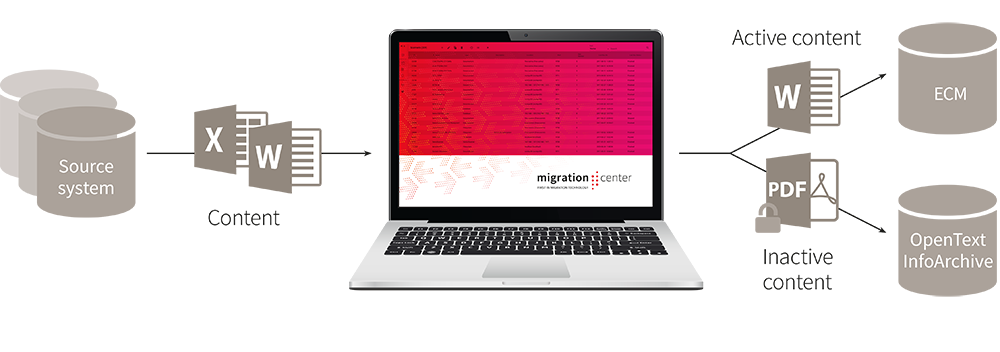
Data reduction: Migrating active content to a new ECM solution while archiving inactive content to an enterprise archive like OpenText InfoArchive.
In my opinion, if companies manage to pay special attention to the above challenges (such as a detailed analysis of legacy applications and data structure, a thorough definition of the new classification and mapping strategy, and industry-specific regulations) already in the design and project planning phase, they can turn their migration project into a sustainable success.
Taking into account the importance of (meta-)data quality in content migration, my additional recommendation is to use professional out-of-the-box migration products like migration-center. With custom metadata transformation and mapping capabilities, external information source integration, and AI-based auto-classification modules, migration-center enables you to clean up and increase the quality of your metadata (so you can align them you business needs), retrieve information faster, and optimize compliance.
MEDIA
HELP
OTHER PRODUCTS

 How to benefit from AWS AI in content migration projects